Father of modern China
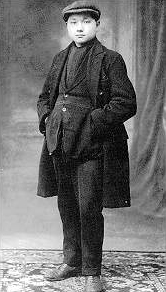 |
| Den Xiaoping student in France |
Chinese students in France in the 20s
The work-study program in which 4,001 Chinese have participated from 1920 to 1927 is detailed in the article Mouvement Travail-Etudes, but in French only... maybe I should translate it. Mao Zedong (毛泽东) decided to stay in China, but he was following with interest the staying of his fellows in France, and among them Den Xiaoping, the youngest one (16 years old!).
Their arrival at Marseille port was quite sensational at the time. In the archives of the newspaper 'Le Petit Marseillais' from 20th october 1920, we can read: "Hundred Chinese aged from 15 to 25 arrived in Marseille, wearing Western suits, one beret and sharp shoes. Courteous, they are waiting on the deck of the boat André Lebon".
Because of funding problems of the program, the students quickly realized they hard to work hard to make a living with low salaries. They worked in the manufactures in the North of France, under very tough conditions. It the was the first occasion for Den to witness directly the practices and abuses from capitalism of the time. But it was also a great source of bonding between these Chinese students.
French roots of the Asian communist leaders
 |
| François Mitterand and Den Xiaoping |
It is very interesting to see how are forged the early influences of major characters: just imagine the culture shock and discoveries in the case of Deng, coming from the far province of Sichuan. He was famous for his strong Sichuanese accent during his speeches in Mandarin, I am really curious to know how it was in French :-) Interestingly, he discovered marxism in France because Marx books were not translated in Chinese yet... and then he started revolutionary meetings. Many of the future Chinese Communist Party leaders were part of this group of students in France. Actually, this part of Chinese history is still taught in Chinese schools. Many other Asian revolution leaders were trained and inspired in France and Paris, among them Ho Chi Minh and Pol Pot. Eventually, Den and his friends got attention from the French police, so they finally escaped to Moscow in January 1926.
Den never forgot this period of his life. Hence, when he visited France years later in 1975 as the Vice-President of China, he requested "a croissant from Montargis". Even if his living conditions were tough during that period, he still had good memories of the local bakeries :-)
Importance of overseas exposure
My point is not to debate about politics here, and acknowledge all the opinions and actions of the fore-mentioned leaders. But it is very insightful to see that their overseas experience was key in their life. Self-development is strongly influenced by interactions and shared experiences with others, especially in a different environment. Surprisingly, many say that Den Xiaoping Communist enlightenment and training occurred in Moscow, when he was in Sun Yat Sen university. However important, I doubt that these 6 months were more influential than 5 years spent in France in forging Den vision of politics and position of China in the world. Deng was very quiet about his past, but we can assume his personal journey was similar to the one of Nie Rhongzhen, another Sichuanese communist leader who studied in Belgium during the same period: "This period of my life had a very deep influence on my mindset. Indeed it was the time when I totally changed the foundations of my vision of the world, and when I committed to the path of revolution. The starting point of revolution is forever unforgettable."
Positive aspects of globalization
 |
| Globalization is not only about this! |
The current globalization is the source many fears because of the economic and environmental imbalances it creates. But globalization is not only about the flow of finance and goods, but also about the people. What happens right now is that an unprecedented part of world population is living overseas: 214 million migrants worldwide, according to International Organization for Migration, and it could reach 405 million in 2050. True, the conditions of many of these migrants are far from being ideal, some being clearly exploited or exposed to local intolerance. Nevertheless, this has a tremendous effect in terms of exposure to different culture and building relationships between individuals, which will of course be amplified by the social networks. When you look at the impact on the world that a few thousands Chinese had after their studies in France, just try to imagine the scale of the coming wave!
As a conclusion, at a more personal and humble level, I think my decision to move to Asia, starting in Singapore, is the good one. Indeed, we are entering an unclear but exciting time of shifting of the geopolitic and economic centre of gravity. Therefore, it is crucial to leave his comfort zone and be exposed to diversity. Even if it means leaving one the most beautiful cities in the world ;-)
Sources
- L'empreinte laissée par Deng Xiaoping en France (French) - The fooprint of Den Xiaoping in France
- Les années françaises de Deng Xiaoping (French) - The French years of Den Xiaoping

Aucun commentaire:
Enregistrer un commentaire